

Blue Hydrogen Market Growth Projected USD 38,820 Million, at a 53.1% CAGR by Driving Global Demand and Trends Till 2035
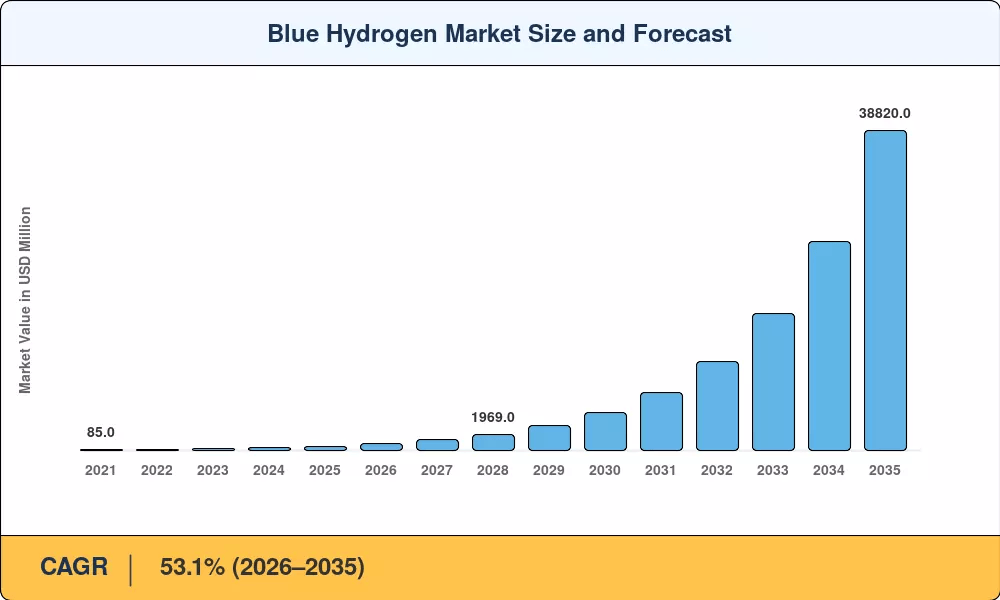
Blue Hydrogen Market Summary
Asia-Pacific held the largest share in 2025, underpinned by Japan and South Korea's national hydrogen strategies and long-term offtake contracts.
Steam Methane Reforming + CCS commanded roughly 57% of the blue hydrogen market in 2025, reflecting the installed base advantage of conventional reformers retrofitted with capture equipment.”
NY, CA, UNITED STATES, July 15, 2026 /EINPresswire.com/ -- Blue hydrogen refers to hydrogen produced from natural gas through steam methane reforming (SMR) or autothermal reforming (ATR), coupled with carbon capture and storage (CCS) to mitigate CO₂ emissions. The captured carbon is transported and stored permanently in geological formations, making blue hydrogen a low-carbon alternative to conventional "grey" hydrogen while leveraging existing natural gas infrastructure.— Arti Dhapte
Blue Hydrogen Market Overview
The Blue Hydrogen Market share reached an estimated USD 540 Million in 2025, positioning it as one of the fastest-scaling energy transition verticals globally. Starting from a forecast base of USD 840 Million in 2026, the blue hydrogen market is projected to surge to USD 38,820 Million by 2035, registering a CAGR of 53.1% across the forecast period. Two policy catalysts anchor that trajectory: the United States' Inflation Reduction Act Section 45V production tax credit, which offers up to USD 3/kg for low-carbon hydrogen, and the European Union's Renewable Fuels of Non-Biological Origin (RFNBO) mandate that pulls blue hydrogen into industrial decarbonization targets.
The market is experiencing unprecedented growth driven by several key factors. The U.S. Inflation Reduction Act's Section 45V provision provides a tiered tax credit up to USD 3.00 per kilogram for hydrogen generated with lifecycle emissions below 0.45 kg CO₂e/kg H₂. Blue hydrogen projects using ATR coupled with 95%+ capture rates qualify for the top tier, effectively eliminating the cost differential with unabated grey hydrogen. The credit's 10-year lifespan through 2032 provides developers with bankable revenue predictability that has spurred over USD 20 billion in announced Gulf Coast project commitments.
Industry trends indicate a generational shift in reforming technology from legacy steam methane reforming units capturing less than 60% of CO₂ to next-generation autothermal reforming plants equipped with carbon capture units that achieve 95%+ capture rates. Shared carbon capture infrastructure in the North Sea, the U.S. Gulf Coast, and Alberta is lowering project CAPEX by an estimated 25-35%. The U.S. Department of Energy's Regional Clean Hydrogen Hubs program has directed USD 7 billion across seven hubs, with at least three featuring blue hydrogen as a primary production pathway.
Technological developments are reshaping the market landscape. AI-driven plant optimization and predictive CCS monitoring are beginning to optimize reformer heat integration and predict CO₂ plume migration in storage reservoirs, reducing energy intensity in hydrogen production by 8-12%. Digital measurement, reporting, and verification platforms enable real-time tracking of CO₂ sequestered, unlocking new revenue streams through carbon credit monetization. Hydrogen-ready gas turbines from GE Vernova and Mitsubishi Power are creating demand channels that could absorb 10-15% of blue hydrogen output by the early 2030s.
Policy and regulatory influence continues to shape market dynamics. Europe's delegated acts under RED III mandate that 42% of hydrogen consumed by industry by 2030 should be renewable or low-carbon. The EU's Hydrogen Certification Scheme and the IPHE's methodology for lifecycle greenhouse gas accounting will standardize environmental claims across markets. Japan's Green Growth Strategy targets 12 million tonnes of annual hydrogen imports by 2040, with ammonia co-firing in thermal power plants as a near-term demand anchor.
Asia-Pacific dominates the blue hydrogen market with approximately 35.4% of global revenue in 2025, driven by blue-ammonia back-haul corridors linking Saudi Arabia and Australia to Japan and South Korea. North America follows at 28.2% share, buoyed by 45V economics and Gulf Coast sequestration capacity. Europe holds a 24.8% share, with the North Sea CO₂ storage cluster underpinning projects in the UK, Norway, and the Netherlands.
Get Free Sample Report for Detailed Market Insights:
https://www.marketresearchfuture.com/sample_request/11197
Blue Hydrogen Market Segmentation
By Technology
Steam Methane Reforming + CCS: Commanded roughly 57% of the blue hydrogen market in 2025, reflecting the installed base advantage of conventional reformers retrofitted with capture equipment
Autothermal Reforming + CCS: Fastest-growing technology segment, driven by 95%+ capture efficiency and top-tier subsidy eligibility
Gas Partial Oxidation + CCS: Niche heavy-residue feedstock applications valued at USD 38 million
Natural-Gas Pyrolysis: Emerging technology with solid carbon co-product value and no CO₂ storage requirement
Others: Includes emerging catalytic and membrane technologies
By End-User Industry
Refining: Accounted for approximately 36% of demand in 2025 as refiners blended blue hydrogen into existing grey hydrogen supply chains
Chemicals: Growing at 52.4% CAGR for ammonia and methanol feedstock decarbonization
Iron and Steel: Valued at USD 65 million for DRI-based steelmaking hydrogen injection
Transportation: Highest growth rate among end-user verticals, spurred by heavy-duty trucking and maritime bunkering pilots
Other Industries: Glass, food processing, electronics
Competitive Landscape / Key Players
The blue hydrogen market exhibits medium concentration, with the top five players accounting for an estimated 35-42% of global capacity. The competitive field spans integrated oil and gas majors, industrial gas specialists, and EPC firms.
Air Products (~8-11% revenue share): Large-scale blue H₂ projects, NEOM ammonia JV, integrated producer with global distribution network.
Shell (~7-10%): Holland Hydrogen I, Scotford upgrader CCS, leveraging upstream gas and North Sea storage assets.
Linde (~6-9%): Reformer technology licensing, Gulf Coast pipeline, technology licensor and contract hydrogen supplier.
Air Liquide (~5-8%): Normandy CCS retrofit, autothermal reforming R&D, European cluster leadership with long-term take-or-pay contracts.
bp (~4-7%): H2Teesside, Net Zero Teesside CCS cluster, integrated energy major with UK industrial cluster anchor.
Other notable players include Equinor, Saudi Aramco, TotalEnergies, ExxonMobil, and Technip Energies. Recent developments include Air Products' FID on a USD 4.5 billion blue hydrogen-to-ammonia facility in Louisiana, and Equinor completing the first commercial-scale CO₂ injection at the Northern Lights facility offshore Norway in August 2025.
Latest Industry News & Developments
Air Products (October 2021): Announced FID on a USD 4.5 billion blue hydrogen-to-ammonia facility in Louisiana, targeting 1.2 million tonnes per year of production capacity with dedicated CO₂ sequestration in Gulf Coast saline formations.
Equinor (August 2025): Completed the first commercial-scale CO₂ injection at the Northern Lights facility offshore Norway, validating the cross-border CO₂ shipping model that underpins multiple European blue hydrogen market projects.
U.S. Department of Energy (December 2023): Finalized selections for seven Regional Clean Hydrogen Hubs under the USD 7 Billion H2Hubs program, with three hubs explicitly incorporating blue hydrogen production.
European Commission (February 2023): Published the delegated act defining low-carbon hydrogen under RED III, confirming blue hydrogen's eligibility for industrial decarbonization compliance credits subject to lifecycle emission thresholds.
You can buy this market report at:
https://www.marketresearchfuture.com/checkout?currency=one_user-USD&report_id=11197
Blue Hydrogen Market Regional Analysis
Asia-Pacific
Asia-Pacific held the largest share of the blue hydrogen market in 2025 at 35.4%, underpinned by Japan and South Korea's national hydrogen strategies and long-term offtake contracts. Japan's Green Transformation (GX) bonds—totaling JPY 20 trillion over ten years—earmark significant allocations for ammonia and hydrogen procurement. South Korea's Hydrogen Economy Roadmap targets 3.9 million tonnes of hydrogen supply by 2030. China accounts for USD 42 million in regional revenue with Sinopec blue hydrogen integration and Ordos CCS projects. Australia's CarbonNet and Murchison Hydrogen projects position the country as a future blue-ammonia exporter to Northeast Asian buyers.
North America
North America holds a 28.2% share, with the United States accounting for approximately 82% of regional revenue. The Gulf Coast has emerged as a global blue hydrogen export hub, with ExxonMobil's Baytown project and Air Products' NEOM-linked Louisiana facility representing anchor investments exceeding USD 10 billion combined. Canada's Alberta province leverages decades of CO₂-enhanced oil recovery expertise to offer some of the lowest sequestration costs globally. Mexico's activity remains limited to early-stage refinery integration studies under Pemex.
Europe
Europe accounts for a 24.8% share, with the North Sea CO₂ storage cluster underpinning projects in the UK, Norway, and the Netherlands. The United Kingdom leads with approximately 31% of regional share through the East Coast Cluster and HyNet Northwest. Germany's National Hydrogen Strategy supports a 52.8% CAGR, building ammonia import terminals at Wilhelmshaven and Brunsbüttel. Norway's Northern Lights project accepted its first third-party CO₂ in 2024, providing open-access storage infrastructure.
Rest of the World
The Middle East & Africa holds a 7.6% share, benefiting from the world's lowest-cost natural gas feedstock. Saudi Aramco shipped the world's first commercial blue-ammonia cargo to Japan in 2020 and has since scaled demonstration volumes. ADNOC's Habshan facility in Abu Dhabi is designed to become one of the largest blue hydrogen production sites globally. South America holds a 4.0% share, with Brazil's Petrobras leveraging extensive subsurface characterization data from pre-salt operations, while Argentina's Vaca Muerta shale formation provides low-cost gas feedstock for potential export projects.
Blue Hydrogen Market Challenges & Opportunities
Key Restraints
Green hydrogen cost reduction trajectory presents the most significant long-term challenge, with IRENA estimating electrolyzer costs could decline by 40-50% by 2030, potentially pushing green hydrogen below USD 2/kg in locations with excellent renewable resources. CO₂ storage permitting and long-term liability uncertainty in the U.S. currently delays projects by 12-18 months. Methane leakage lifecycle concerns, with upstream leakage rates above 3.5% potentially eroding blue hydrogen's emissions advantage entirely, necessitate additional monitoring and certification costs of USD 0.10-0.25/kg. Fossil-fuel lock-in criticism from ESG investors and subsidy phase-out risks further constrain growth.
Emerging Opportunities
Industrial cluster hydrogen hubs in concentrated zones like the Houston Ship Channel, the Humber in the UK, and Rotterdam-Moerdijk offer the chance to serve multiple offtakers from a single production facility, reducing per-unit transport expenses by up to 40%. Retrofitting grey hydrogen assets, with roughly 70 million tonnes of grey hydrogen consumed annually globally, offers bolt-on carbon capture at 30-40% lower cost than greenfield ATR plants. Emerging markets in the Middle East and South America with abundant low-cost natural gas reserves and favorable geological storage position these regions as future export hubs. Carbon credit and digital MRV monetization through real-time tracking of sequestered CO₂ unlocks new revenue streams. Maritime bunkering and heavy transport corridors under the IMO's revised GHG strategy create regulatory pull for low-carbon bunkering fuels.
Future Potential
AI-driven plant optimization and predictive CCS monitoring will continue to reduce energy intensity and storage liability risk. The electrification supercycle and grid-balancing hydrogen demand, as renewable penetration crosses 40-50% in major grids, will create dispatchable backup capacity opportunities. ESG reporting standards and certification schemes through the EU's Hydrogen Certification Scheme will drive offtaker confidence and unlock green-bond financing. Platform economics and hydrogen-as-a-service models will expand the customer base beyond traditional refinery and petrochemical buyers.
To explore more market insights, visit us at:
https://www.marketresearchfuture.com/reports/blue-hydrogen-market-11197
The global Blue Hydrogen Market is positioned for exceptional growth, with projections indicating expansion from USD 840 million in 2026 to USD 38,820 million by 2035 at a staggering 53.1% CAGR. Market dynamics are driven by the convergence of policy catalysts including the U.S. Section 45V production tax credit, EU RFNBO mandates, and national hydrogen strategies across Asia-Pacific. The shift from legacy SMR units to ATR plants with 95%+ capture rates and shared CCS hub infrastructure is transforming production economics.
Asia-Pacific leads the market with 35.4% share and the highest growth rate, driven by blue-ammonia trade corridors and long-term offtake agreements with Japan and South Korea. North America follows at 28.2% share, buoyed by 45V economics and Gulf Coast sequestration capacity. Europe holds 24.8% share with North Sea storage clusters underpinning projects in the UK, Norway, and the Netherlands. While challenges including green hydrogen cost competition and storage permitting delays persist, the long-term industry outlook remains robust, supported by the essential role of blue hydrogen in enabling industrial decarbonization, refining operations, chemicals production, and heavy-duty transport. The decade ahead will test whether policy certainty can keep pace with capital commitments now exceeding USD 50 billion in announced project pipelines worldwide.
More Related Reports from MRFR Library:
Commercial Surge Protection Device Market https://www.marketresearchfuture.com/reports/commercial-surge-protection-device-market-32947
Smart Electricity Meter Market https://www.marketresearchfuture.com/reports/smart-electricity-meter-market-32952
Commercial Voltage Regulator Market https://www.marketresearchfuture.com/reports/commercial-voltage-regulator-market-32961
Commercial Electric Boiler Market https://www.marketresearchfuture.com/reports/commercial-electric-boiler-market-32967
Commercial Wire and Cable Market https://www.marketresearchfuture.com/reports/commercial-wire-cable-market-32975
Composite Cylinder Market https://www.marketresearchfuture.com/reports/composite-cylinder-market-32993
Commercial Electrical Conduit Market https://www.marketresearchfuture.com/reports/commercial-electrical-conduit-market-32998
Composite Insulator Market https://www.marketresearchfuture.com/reports/composite-insulator-market-33009
Commercial Energy as a Service Market https://www.marketresearchfuture.com/reports/commercial-energy-as-a-service-market-33027
Containerized Substation Market https://www.marketresearchfuture.com/reports/containerized-substation-market-33060
Larry Wilson
WantStats Research And Media Pvt. Ltd.
+1 855-661-4441
email us here
Visit us on social media:
LinkedIn
Facebook
YouTube
X
Legal Disclaimer:
EIN Presswire provides this news content "as is" without warranty of any kind. We do not accept any responsibility or liability for the accuracy, content, images, videos, licenses, completeness, legality, or reliability of the information contained in this article. If you have any complaints or copyright issues related to this article, kindly contact the author above.
